
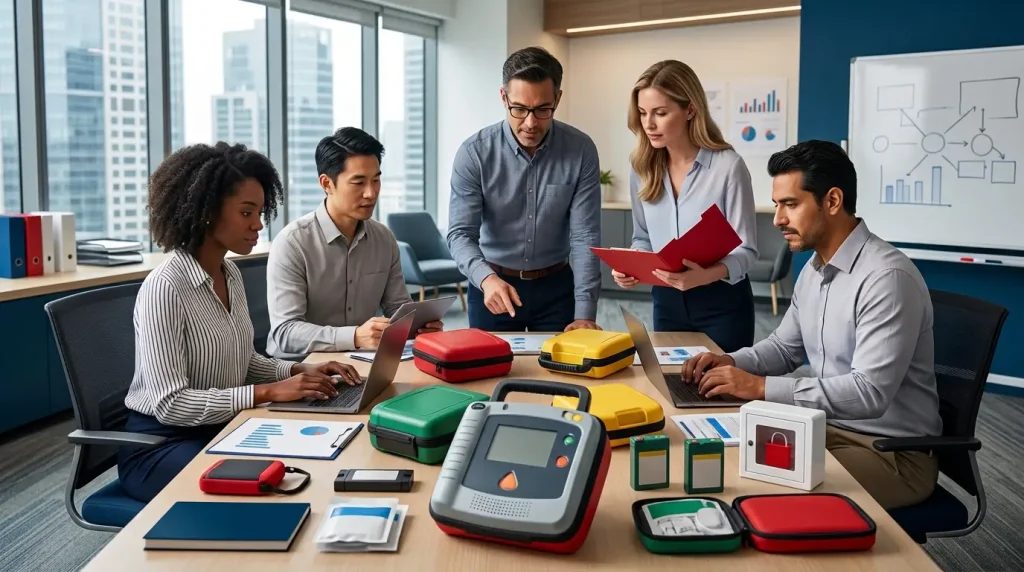
When comparing the automated external defibrillator AED price, organisations should look beyond the cost of the unit alone.
The final purchase may also involve electrode pads, batteries, cabinets, signage, carrying cases, training, inspection requirements and future replacement costs.
A lower initial quotation may therefore be less economical if important accessories or support are excluded.
For corporate offices, factories, schools and institutions, AED selection should also consider the facility layout, operating environment, number of users and the organisation’s emergency-response procedures.
Procurement teams may need to compare not only price, but also usability, model type, package inclusions, warranty terms, after-sales support and the long-term cost of maintaining the AED in a ready-to-use condition.
AIDEL supplies AED products, spare parts and related accessories, while also supporting organisations with product-selection guidance and First Aid, CPR and AED training.
This guide explains 10 practical buyer-survey facts to evaluate before comparing AIDEL’s DDU-100E Lifeline Semi AED and DDU-120E Lifeline Fully AED.
Exact prices, technical specifications, package inclusions and commercial terms should be confirmed directly with AIDEL before purchase.
An AED quotation may cover more than the defibrillator unit itself.
Depending on the supplier and package, it may also include batteries, electrode pads, a carrying case, a wall cabinet, signage or other supporting accessories.
Organisations should not assume that every quotation includes the same components.
Before comparing prices, procurement teams should request an itemised quotation showing:
AIDEL supplies AED products, replacement electrodes, batteries, cabinets, wall mounts, signage and other related accessories.
Buyers can also explore its AED solutions and spare parts when planning a complete workplace AED station rather than purchasing the unit in isolation.

The appropriate budget depends on more than the advertised unit price.
Workplace size, the number of required units, model selection, accessories, training and future replacement components can all affect the overall purchase.
A small office considering one AED may have different requirements from a factory, campus or multi-storey institution that needs several units across separate operational areas.
A practical budget should therefore separate:
Procurement teams should request a written quotation based on the actual number of units, facility type and required accessories.
AIDEL offers the DDU-100E Lifeline Semi AED and the DDU-120E Lifeline Fully AED.
The selection should not be based on price alone. Organisational buyers should consider:
Procurement teams should ask AIDEL to explain the operational difference between the two models and demonstrate how each device is intended to guide a responder.
An AED may be used during a stressful emergency, so the clarity of its instructions is an important purchasing consideration.
During product evaluation, buyers should ask:
Usability should be assessed from the perspective of the people most likely to respond, including appointed first aiders, safety personnel, emergency-response teams and other authorised employees.
A clear user interface may support confidence, but no AED should be treated as a substitute for suitable emergency procedures and practical training.
The battery is part of the AED’s long-term ownership cost. Buyers should understand its expected service requirements before approving a purchase.
Questions to include in the buyer survey are:
The organisation should assign responsibility for routine AED checks rather than assuming that the device will remain ready indefinitely after installation.
Electrode pads are another important recurring cost. Procurement teams should check what is supplied initially and what may be required later.
The quotation should make clear:
Facilities serving children, such as schools or educational institutions, should discuss their intended user population with AIDEL before selecting the appropriate configuration.
An AED selected for an administrative office may face different conditions from one installed in a factory, warehouse, workshop, school, outdoor facility or high-traffic public area.
The buyer survey should consider:
The device and storage arrangement should suit the location where it will be installed.
Where environmental exposure is a concern, buyers should ask whether an appropriate cabinet, enclosure or alternative placement is needed.
An AED may be difficult to locate or access if it is stored without proper planning.
Accessories can therefore influence both the purchase price and the practical usefulness of the AED station.
Depending on the workplace, the organisation may need:
Accessories should be selected according to the facility layout and internal emergency plan. Procurement teams should avoid buying an accessory package without checking whether each item suits the intended location.
AIDEL can assist organisations in considering AED accessories alongside the main unit, helping buyers prepare a more complete quotation.
Equipment purchase and responder readiness should be considered together.
An organisation may own an AED but still have employees who are unfamiliar with its location, internal emergency procedures or expected response roles.
Before approving the quotation, ask:
AIDEL offers training covering First Aid, CPR, AED usage and workplace emergency-response topics.
Training may be considered alongside equipment selection when the organisation is developing or strengthening its emergency plan.
Training does not guarantee a particular emergency outcome, but it may help employees understand their roles, equipment locations and response procedures.
The lowest quotation may not provide the best long-term value if support is difficult to obtain after the purchase.
Procurement teams should ask the supplier:
Written warranty and support information should be reviewed before issuing a purchase order.
Verbal assurances should not replace documented commercial terms.
AIDEL provides product-selection guidance and customer support, but the exact level of support for each AED purchase should be clearly stated in the quotation.
The total cost of ownership combines the initial purchase with foreseeable costs throughout the organisation’s intended period of use.
It may include:
A quotation that appears more expensive initially may include accessories or support that are excluded from a lower-priced offer.
For this reason, organisations should compare the complete ownership package rather than one headline number.
A simple comparison table can help:
Cost Area | Supplier A | Supplier B | Supplier C |
AED unit | Confirm | Confirm | Confirm |
Electrode pads | Confirm | Confirm | Confirm |
Battery | Confirm | Confirm | Confirm |
Cabinet and signage | Confirm | Confirm | Confirm |
Carrying case | Confirm | Confirm | Confirm |
Training | Confirm | Confirm | Confirm |
Warranty | Confirm | Confirm | Confirm |
After-sales support | Confirm | Confirm | Confirm |
Estimated replacement costs | Confirm | Confirm | Confirm |
Total evaluated cost | Confirm | Confirm | Confirm |
This format helps decision-makers identify exclusions before selecting a supplier.

All suppliers should be asked to quote against the same written requirements.
Otherwise, one supplier may quote only the AED unit while another includes accessories, training and replacement components.
A fair request for quotation should specify:
Procurement teams should then compare quotations using three categories:
Technical suitability
Does the proposed model and configuration suit the facility, users and operating environment?
Commercial completeness
Does the quotation clearly state every included and excluded component?
Ongoing support
Can the supplier provide compatible replacement parts, product guidance, training and after-sales assistance?
Price should remain an important factor, but it should be assessed together with suitability, completeness and support.
AIDEL’s DDU-100E and DDU-120E give organisational buyers two AED options to consider.
The more suitable model will depend on the intended users, internal procedures, workplace conditions and preferred operating approach.
A procurement decision should be made after reviewing the product information, requesting a demonstration where available and discussing the organisation’s requirements with AIDEL.
The DDU-100E may be considered by organisations evaluating a semi-automatic AED configuration.
Before selecting it, ask AIDEL to confirm:
The DDU-100E Lifeline Semi AED product page can be reviewed as the starting point for a formal quotation and model-specific discussion.
The DDU-120E may be considered by organisations evaluating a fully automatic AED configuration.
Buyers should ask AIDEL:
The DDU-120E Lifeline Fully AED product page provides a reference point for discussing the required package with AIDEL.
There is no single quantity that suits every organisation. The number of units should be considered according to the actual facility rather than employee numbers alone.
Relevant factors include:
A large facility may require several AEDs so that employees do not need to travel across distant work areas to retrieve one.
A smaller office may require fewer units but should still consider visibility and accessibility.
Organisations should map proposed locations and discuss their layout, occupancy and risk profile with AIDEL before finalising the quantity.
This assessment is general planning guidance and should not be presented as a guarantee of regulatory compliance or emergency-response performance.
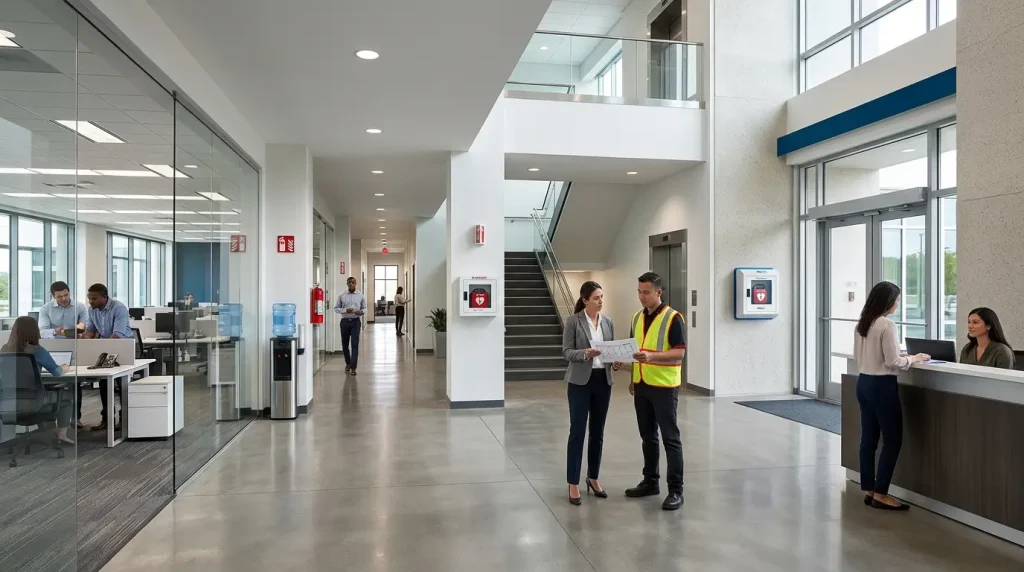
AED placement should support visibility and practical access while protecting the device from unsuitable environmental conditions.
Potential locations may include:
The selected location should be:
The organisation should also communicate AED locations during staff induction, emergency exercises and relevant training.
A detailed enquiry helps AIDEL understand the required equipment and prepare a more relevant quotation.
Provide the following information:
Where the organisation is uncertain about the model or quantity, it should describe the facility and intended use rather than selecting solely according to the lowest visible price.
AIDEL supplies AEDs, batteries, replacement electrodes, cabinets, wall mounts, signage and related accessories for workplace and institutional environments.
It also provides product-selection guidance and First Aid, CPR and AED training.
Its support may help organisations consider:
The final selection should still be based on the organisation’s facility, users, internal procedures, operating environment and approved budget.
Purchasing an AED alone does not automatically make a workplace fully prepared or compliant.
The automated external defibrillator AED price should be evaluated as part of a complete workplace-readiness package, not as a standalone equipment cost.
The AED model, batteries, electrode pads, cabinet, signage, carrying accessories, training, warranty terms and future replacement requirements can all affect the final value of a quotation.
For corporate organisations, factories and institutions, the most suitable option depends on the facility layout, operating environment, intended users, internal emergency procedures and required level of support.
Procurement teams should compare quotations using the same specifications and confirm all inclusions, exclusions and recurring costs before issuing a purchase order.
AIDEL supplies AED products, replacement components and related accessories while supporting organisations with product-selection guidance and First Aid, CPR and AED training.
Exact prices, model specifications, package inclusions, warranty terms and stock availability should be confirmed directly with AIDEL.
Review the DDU-120E Lifeline Fully AED if your organisation is considering a fully automatic AED.
When requesting a quotation, provide AIDEL with your facility type, proposed locations, required quantity, accessory requirements and training needs.
This will help the team prepare a more relevant recommendation and itemised quotation.
AED prices may differ because quotations can involve different models, accessories, battery and electrode configurations, warranty terms, training arrangements and after-sales support.
A lower-priced quotation may exclude items that another supplier includes.
Organisations should therefore compare itemised quotations rather than the headline unit price alone.
This depends on the quotation and package offered. Buyers should confirm whether the AED includes its initial battery and electrode pads, and whether spare or replacement components must be ordered separately.
Organisations requiring AEDs for several buildings, floors or work areas may request a quotation based on their proposed quantity and facility layout.
The enquiry should specify the number of units, intended locations, accessories and training requirements.
They should be considered when planning the overall AED programme.
Cabinets, signage, carrying cases, replacement components and training may affect whether the equipment can be stored, identified and managed effectively.
The exact requirements will depend on the organisation’s facility, users and internal emergency procedures.
Inspection and replacement requirements depend on the AED model, component condition, expiry information, manufacturer guidance and whether the equipment has been used.
Organisations should assign a responsible person to monitor the AED, battery, electrode pads and storage accessories.
