
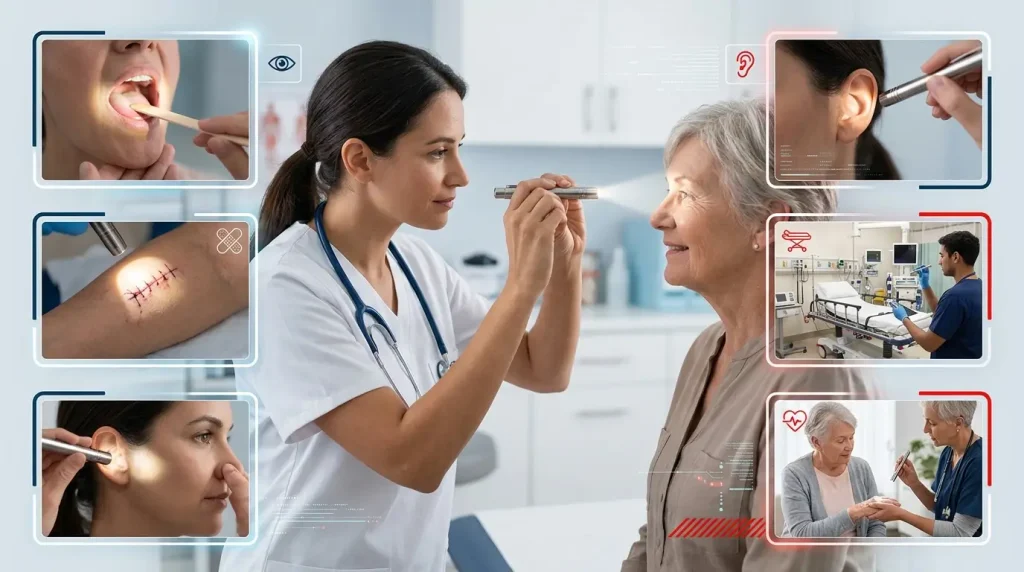
It means a penlight is not just a simple torch for quick visual checks; in clinics, workplace sickbays, and first-response settings, it supports pupil assessment, throat inspection, skin checks, and fast observation where accurate illumination affects decision-making.
A penlight works by delivering focused, portable illumination in a slim pen-style body, allowing doctors, nurses, EMTs, caregivers, and safety personnel to perform one-handed assessments such as checking pupil response, inspecting the throat, and viewing hard-to-see areas quickly.
Readers should evaluate whether their clinic, factory, school sickbay, or emergency response setup has the right penlight specification, then match it with broader workplace readiness needs such as organized assessment tools, infection control items, and dependable replenishment planning.
A penlight remains one of the most practical handheld diagnostic tools in clinics, workplace sickbays, training environments, and first-response settings because it delivers fast, focused illumination for visual checks that cannot wait for bulky equipment.
For healthcare institutions, private practices, safety officers, caregivers, and factories, its value goes far beyond basic examination when quick pupil observation, oral inspection, wound visibility, and low-light assessment are part of daily operations.
In Malaysia, where many organizations need dependable medical supplies, efficient procurement, and practical workplace readiness, a penlight is a small tool that supports faster decisions, cleaner workflows, and better frontline confidence.
Although it looks simple, a penlight plays an important role in routine assessment. Medical staff use it to observe pupil reaction, inspect the throat, check superficial skin conditions, and improve visibility in tight or poorly lit areas.
Safety and health officers may also rely on it when reviewing workplace clinic preparedness, especially in settings where compact, portable tools are easier to store, carry, and deploy.
That is why this article focuses on six main usage examples of a penlight and what those examples reveal about its real-world value.
Instead of treating it as an ordinary flashlight, we will look at how the tool supports clinical efficiency, practical examination, and organized care delivery for professionals and facilities that need reliable equipment every day.
A penlight remains essential because it combines focused illumination, portability, and fast one-handed operation, making it useful for healthcare examination, workplace clinic checks, and caregiver support where speed and visibility matter.
A penlight is a slim handheld light designed to resemble a pen, but its real strength lies in practical assessment rather than simple convenience.
In healthcare environments, it is often used during fast visual checks where a larger flashlight would be awkward or excessive.
In workplace settings, it is equally useful because safety and health officers need tools that are compact, easy to store, and ready to use during routine observation or minor incidents.
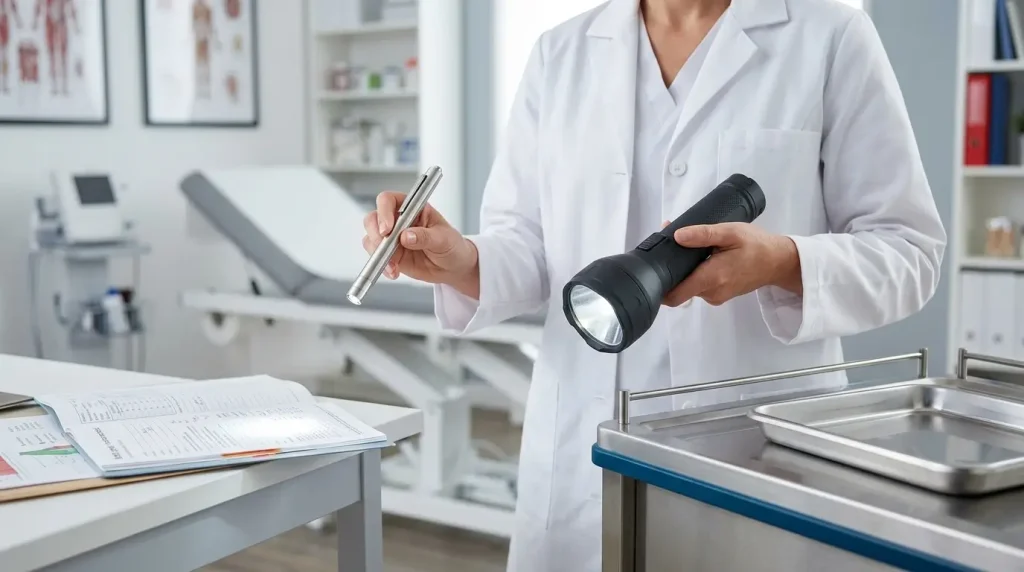
A penlight differs from a standard flashlight because it is built for close-range examination, controlled beam focus, and quick clinical handling rather than broad-area illumination or outdoor heavy-duty use.
The difference is important.
A general-purpose flashlight is often brighter and wider in beam spread, which can be helpful in security or maintenance work, but less practical for checking pupils, the throat, or a small wound.
A penlight gives a narrower, more controlled light source that supports quick examination without unnecessary glare or bulk.
Portability, focused illumination, and one-handed use matter because healthcare workers, caregivers, and first responders often need to stabilize a patient, move equipment, or document findings while using a compact diagnostic light.
In daily care, small design advantages become operational advantages.
A shirt-pocket clip, lightweight body, and simple push-button activation help the user access the tool within seconds.
This is especially relevant in clinics, sickbays, ambulances, schools, and factory medical rooms where delays can interrupt assessment flow.
A useful penlight usually includes an LED light source, durable casing, pocket clip, reliable power source, and a beam pattern suitable for close-up inspection. Some models also include a pupil gauge, which helps during neurological observation. These features make the tool more than an accessory; they make it dependable.
A useful penlight usually includes an LED light source, durable casing, pocket clip, reliable power source, and a beam pattern suitable for close-up inspection.
Some models also include a pupil gauge for neurological observation. For buyers comparing specifications in more detail, understanding which pen torch features matter most can help when evaluating brightness, beam quality, durability, battery type, hygiene requirements, and handling comfort for different working environments.
Pupil response is one of the most important uses because it gives quick neurological information that can support early recognition of head injury, altered consciousness, or abnormal eye response.
This is why penlights are standard in many nursing kits, emergency trolleys, and clinic drawers. The tool helps professionals perform a basic but meaningful observation without relying on larger diagnostic devices. Even in non-hospital environments, such as workplace first-aid rooms, this function can be useful during initial assessment before referral.
Pupil gauge markings improve quick neurological observation by helping users estimate pupil size more consistently, especially during repeated checks or when documenting visible changes.
While a penlight does not replace full diagnostic ophthalmic equipment, it supports fast frontline observation. For safety officers and trained responders, this matters because the goal is often to identify whether further evaluation is needed, not to perform a specialist examination.

During routine observation, a penlight helps confirm normal visual response and document findings efficiently. During urgent triage, it becomes a fast screening tool that supports escalation decisions, especially when combined with symptom review, vital signs, and clinical judgment.
A penlight improves throat, oral cavity, and basic ENT inspection by illuminating confined anatomical areas where ambient room lighting is often insufficient for safe, accurate visual observation.
The mouth and throat are common examples of areas where even a well-lit room may not provide enough visibility. A penlight makes it easier to identify redness, swelling, lesions, foreign material, or general signs of irritation. This is useful for clinics, school health rooms, and caregiving environments where quick inspection is needed before deciding on further action.
Direct light helps because structures inside the mouth and throat are naturally shadowed, and focused illumination makes color changes, tissue condition, and visible abnormalities easier to recognize.
The same logic applies to simple ear, nose, and superficial area checks. A penlight supports observation, but it does not replace specialized ENT tools. Its value lies in being available, portable, and immediately useful during preliminary assessment.

A penlight supports basic ear, nose, and superficial examination by improving visibility of external structures and helping the examiner notice obvious irritation, swelling, discharge, or surface-level concerns.
For caregivers and private practices, this practical use matters because not every situation requires complex equipment. Sometimes, better light is the difference between missing a visible issue and noticing it early enough to respond appropriately.
A penlight supports screening and initial inspection, but it is not a substitute for an otoscope, slit lamp, or other purpose-built diagnostic instruments. It should be treated as a frontline examination aid, not a complete diagnostic solution.
A penlight is valuable for skin, wound, and hard-to-see area checks because it improves visibility in close-range assessment, helping users observe color, moisture, edges, and surface detail more clearly.
In wound care and basic inspection, lighting quality affects what the examiner can see. Poor lighting can hide bruising, dried blood, irritation, or foreign particles. A penlight helps improve contrast and allows the user to inspect small areas without repositioning the patient excessively.
Focused light improves visibility by directing attention to a limited area, reducing shadows, and making skin texture, wound margins, and superficial changes easier to observe during examination.
This can be helpful in home care, occupational health rooms, event medical support, and emergency kits. It is also useful when the affected area is partially covered, in a corner, or difficult to expose under normal room lighting.
Caregivers, nurses, and first responders benefit because quick illumination saves time, reduces handling, and supports more confident assessment when immediate access to larger equipment is not practical.
In real-world care, small tools often solve immediate problems. A dependable penlight supports readiness, especially when combined with organized stock management, staff training, and essential Sickbay Supplies for daily operational use.
A penlight saves time during night rounds, home visits, event standby support, workplace clinic checks, and situations where users need to inspect pupils, the throat, skin, or tight spaces quickly. Its value comes from readiness, not complexity.
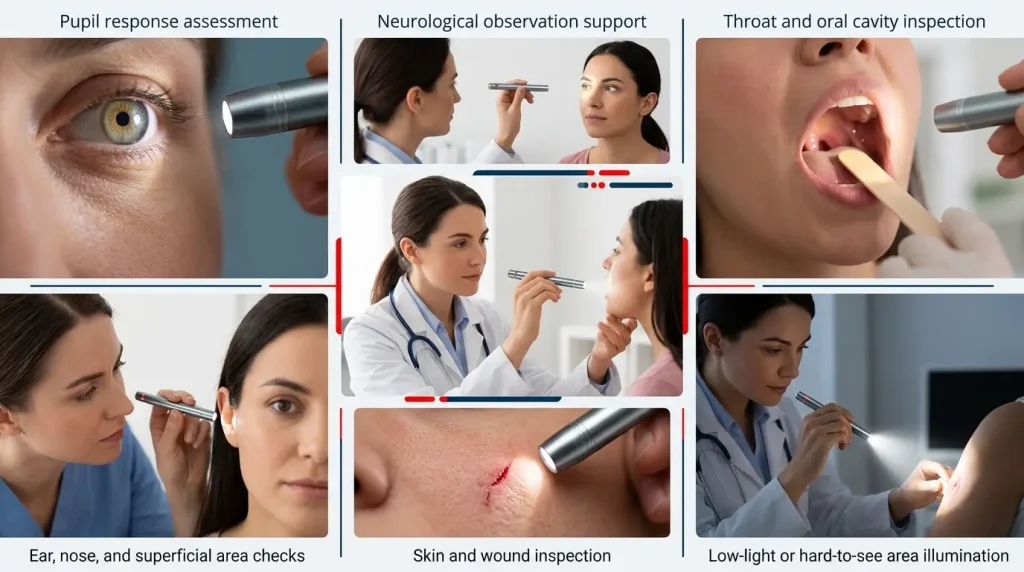
The six main usage examples show that a penlight delivers practical diagnostic support, workflow efficiency, and frontline readiness across clinics, workplace health rooms, caregiving environments, and emergency response situations.
Pupil response assessment shows how a penlight helps users gather immediate neurological clues with a simple, controlled beam and minimal setup.
Neurological observation support shows that penlights contribute to repeated monitoring, especially when staff must compare visible pupil changes over time.
Throat and oral cavity inspection highlights the penlight’s role in improving visibility inside small, shadowed areas during everyday clinical checks.
Ear, nose, and superficial area checks demonstrate how compact lighting supports preliminary assessment before escalation to specialized examination.
Skin and wound inspection proves that visibility affects decision quality, especially when evaluating superficial injury, irritation, or healing progress.
Low-light and hard-to-see area illumination confirms that penlights remain useful outside direct clinical examination, including workplace safety rooms and mobile care situations.
These six examples matter because they show that the penlight is not a basic extra. It is a low-cost, high-utility tool that supports assessment speed, observation accuracy, and day-to-day readiness across multiple care and safety settings.
A penlight proves its value when speed, visibility, and portability are essential to frontline care. Across pupil checks, throat inspection, skin assessment, and low-light observation, it supports faster preliminary examination in clinics, workplace sickbays, and caregiving environments. For healthcare teams and safety officers, its strength is not complexity but dependable everyday usefulness.
If you are reviewing your clinic, workplace first-aid room, or care setup, it makes sense to choose a reliable examination light that supports quick visual checks without adding unnecessary bulk. A practical next step is to review AIDEL’s Pen Torch Light as part of a wider plan to strengthen your Sickbay Supplies for better readiness, smoother assessments, and more consistent day-to-day support.
A good penlight should offer focused illumination, durable construction, reliable switching, and easy pocket carry so healthcare staff, caregivers, and safety officers can use it quickly in real assessment situations.
Look for an LED light source, a strong clip, a lightweight but sturdy body, and a beam suitable for close-range examination rather than wide-area lighting. For medical or workplace use, consistent brightness and dependable battery performance matter more than extreme power. Models with pupil gauge markings can also be useful for quick neurological observation.
LED penlights generally offer better efficiency, longer service life, and more consistent brightness than older incandescent models, making them more practical for clinics, workplace health rooms, and mobile care settings.
Incandescent lights may still be familiar to some users, but LED models usually produce less heat, use batteries more efficiently, and require less frequent replacement. For organizations that value readiness and lower maintenance disruption, LED penlights are typically the more dependable choice for routine use.
Choosing a penlight for medical use means matching the light to real examination tasks such as pupil checks, throat inspection, wound visibility, and rapid one-handed use during routine or urgent assessment.
Start by checking whether the beam is suitable for close-up inspection and whether the body is slim enough for pocket access. Then consider battery reliability, ease of cleaning, and build quality. In medical and occupational settings, the best choice is not just compact, but also dependable enough for repeated daily use.
The ideal lumen output for a medical penlight is usually one that provides clear, focused close-range visibility without excessive glare, because examination quality depends on control as much as brightness.
For pupil checks, oral inspection, and skin observation, a balanced beam is often more useful than a very powerful light. Extremely bright output can be uncomfortable for patients and less practical for close examination. In most clinical or workplace care situations, a controlled diagnostic beam is preferable to a high-output utility flashlight.
Maintaining a penlight for longevity requires simple habits such as battery checks, clean storage, and routine inspection so the tool stays ready for daily clinical, workplace, or caregiving use.
Replace weak batteries before performance drops, clean the exterior regularly, and store the penlight in a dry, accessible place. Users should also test the switch and beam consistency during routine kit checks. For organizations, including penlights in regular supply audits helps reduce failure during actual assessment needs.
