

A pen torch is a compact inspection light used for quick visual checks, pupil response observation, throat inspection, equipment review, and close-range safety tasks where clear visibility and fast handling matter.
The right pen torch improves task accuracy by combining controlled brightness, a focused beam, dependable activation, and portable design, helping healthcare staff, safety officers, and caregivers work efficiently in tight or low-light conditions.
Readers should match pen torch features to the real environment first, comparing brightness, beam quality, durability, battery type, hygiene needs, and handling comfort before selecting a model for medical, industrial, or home use.
A pen torch may look simple, but in clinics, factories, and caregiving environments, the wrong model can slow inspections, reduce visibility, and make routine checks less reliable.
For healthcare staff, safety officers, and caregivers, this small tool often supports fast close-range assessments where clear light, easy handling, and consistent performance matter more than extra features.
In medical and occupational settings across Malaysia, practical equipment choices affect both workflow and confidence.
A pen torch used for pupil response, throat checks, equipment observation, or quick workplace inspections should be easy to carry, bright enough for the task, and dependable during repeated daily use.
That is especially important for private practices, workplace sickbays, production floors, and home care situations where staff need tools that work immediately without unnecessary complications.
AIDEL operates in a space where equipment quality, usability, and timely supply matter.
Its focus on reliable medical supplies, expert guidance, and responsive service reflects what buyers often need when selecting essential tools for healthcare and safety.
As one customer noted, “Easy to deal with” when sourcing medical items, while another highlighted fast and smooth service for event first aid kit quantities, showing how practical support and dependable supply can shape buying decisions in real settings.
This article breaks down the pen torch features that matter most, so buyers can compare options based on actual use rather than generic product claims.
A pen torch is a compact inspection light that helps healthcare staff, safety officers, and caregivers perform fast visual checks in close-range situations where accuracy, portability, and dependable illumination are essential.

A pen torch supports quick visual checks by giving controlled light for pupil response, throat observation, wound visibility, equipment inspection, and focused workplace checks in areas where overhead lighting is insufficient or impractical.
In clinics and private practices, a pen torch is often used during basic examinations that require direct and immediate visibility.
Medical staff may use it to observe pupil reaction, inspect the mouth or throat, or check small details during patient assessment.
Because these tasks are short and repetitive, the torch must activate quickly and produce a clear, stable beam.
In factories and industrial environments, the same tool serves a different but equally useful purpose.
Safety and health officers, maintenance staff, and supervisors may use a pen torch to inspect panels, labels, machine corners, or low-light workspaces.
A slim light source is easier to carry during rounds and faster to access than larger flashlights.
For caregivers and home users, a pen torch is practical because it simplifies quick checks without adding complexity.
Whether checking a patient’s condition, looking at skin irritation, or locating details in a dim room, the tool is useful when immediate lighting is needed in a compact form.
Portability, visibility, and reliability make a pen torch practical because professionals in healthcare, safety, and caregiving need a light that is easy to carry, quick to access, and consistent across repeated daily use.
A bulky tool creates friction in daily work.
A pen torch, by contrast, fits into a pocket, uniform slot, bag compartment, or workstation drawer without taking much space.
That small form factor matters in fast-moving environments where staff cannot stop to search for equipment.
Visibility is equally important.
A pen torch should not merely turn on; it should deliver usable light for the exact task.
This means the user must be able to direct the beam accurately, avoid unnecessary glare, and see details clearly in close-range situations.
Reliability is what turns a simple product into a trusted tool.
If the switch feels weak, the battery drains too quickly, or the output becomes inconsistent, even a low-cost device becomes inconvenient.
In professional settings, convenience is not enough; dependable daily performance matters more.
The most important pen torch features for professional use are brightness control, beam focus, compact design, durable construction, and dependable power, because these directly affect visibility, handling, and task efficiency across medical and workplace settings.
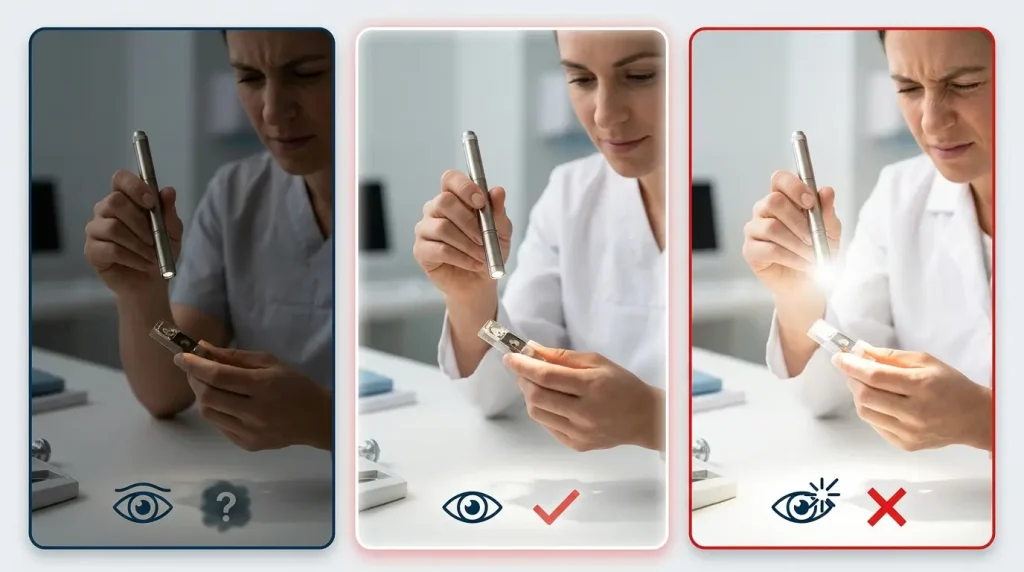
Brightness level affects visibility, comfort, and task accuracy because a pen torch must provide enough illumination for clear observation without causing glare, discomfort, or unnecessary reflection during close-range examinations and inspections.
A torch that is too dim may make details harder to see, especially when checking pupils, oral areas, labels, or small components.
A torch that is too bright can be equally problematic, particularly in medical use where controlled illumination is more useful than harsh intensity.
The right brightness depends on the setting.
In clinics, controlled and comfortable output is often better than aggressive brightness.
In factories, slightly stronger output may help when inspecting darker corners or equipment housings.
For caregivers, moderate brightness is usually more practical because it balances comfort and visibility.
Pen torch brightness should match inspection and examination needs by supporting close-range visibility without overwhelming the eye, creating glare, or reducing comfort during repeated checks in healthcare, industrial, or home care environments.
Choosing brightness should start with the real task.
If the torch will mainly be used for basic clinical observation, the user should prioritize consistent and comfortable illumination.
If the task involves quick inspection of darker machine spaces or storage areas, stronger output may be useful, but beam control still matters.
A buyer should also think about frequency.
A torch used all day should remain comfortable to operate over many short tasks.
This is why practical brightness often matters more than marketing claims.
Beam focus and light consistency improve close-range checks because users need a stable, directed light pattern that highlights details precisely without scattering illumination across irrelevant areas.
A broad or uneven beam can reduce inspection quality. In a clinic, the light should help the examiner focus on a specific point.
In a factory, a focused beam makes it easier to inspect labels, parts, switches, or narrow spaces.
In caregiving, steady light helps reduce guesswork during simple checks.
Consistency matters just as much as focus.
If the light flickers or varies in strength, it becomes distracting and less trustworthy.
A stable beam improves confidence, especially during repeated use.
A focused pen torch beam helps with targeted visual assessment by directing light exactly where the examiner or inspector needs it, improving detail recognition in pupils, oral checks, device surfaces, and narrow inspection points.
This is especially relevant for professional users who do not need a wide floodlight.
The goal is not to light up an entire room, but to isolate a small visual area quickly and clearly.

Size, weight, and pocket clip design affect everyday usability because a pen torch that is slim, light, and secure is easier to carry throughout long shifts and faster to retrieve when immediate lighting is needed.
A compact body improves comfort for doctors, nurses, factory staff, and caregivers who already carry multiple tools.
The torch should feel easy to hold and easy to store. If it is too heavy or awkward, users may avoid carrying it regularly.
The pocket clip is a small feature with practical value.
It helps keep the torch accessible on uniforms, lab coats, pockets, or notebooks. That accessibility reduces time wasted during routine work.
Slim construction helps clinics, factories, and caregivers work faster because it improves portability, reduces hand fatigue, and allows the pen torch to stay within easy reach during rounds, checks, and caregiving routines.
When a tool fits naturally into workflow, it is more likely to be used consistently.
That is one reason why slim pen torch designs remain relevant across multiple industries.
The most important pen torch medical specifications for clinics are controlled brightness, clear beam quality, hygienic design, durable construction, and easy handling, because these features support fast examinations and repeated use in healthcare workflows.
Pupil checks, throat checks, and general observation need the right light output because medical staff require clear, directed illumination that supports accurate visual assessment without causing unnecessary discomfort to patients.
Clinical use is different from general flashlight use.
In healthcare, the torch must assist observation rather than simply produce strong light.
A sharp, comfortable beam helps professionals examine small areas quickly and confidently.
General observation also benefits from consistency.
During repeated patient checks, staff need a tool that behaves predictably every time. A reliable light source supports smoother workflow and better decision-making.
Pen torch medical use benefits from controlled brightness and clear illumination because healthcare examinations often depend on close-range visual clarity, patient comfort, and dependable performance during routine assessments.
In short, the best clinical torch is not necessarily the brightest one. It is the one that provides usable, stable light for repeated real-world medical tasks.
Hygiene, material quality, and durability matter in clinical environments because equipment used regularly in patient-facing settings should be easy to clean, resistant to wear, and dependable during continuous use.
Healthcare tools are handled often, stored often, and moved between work areas.
A weak outer body or poor switch design can shorten product life and affect user trust.
Material choice also influences how well the tool tolerates repeated cleaning and daily handling.
A strong build supports professionalism.
Clinics and private practices usually prefer tools that look clean, feel dependable, and hold up well under regular use.
Facilities that stock Sickbay Supplies often prioritize these same qualities when selecting everyday examination and support equipment.
Reusable and easy-to-clean designs support healthcare workflows by reducing replacement frequency, improving maintenance routines, and helping staff keep frequently used tools ready for safe and efficient daily examinations.
Pen torch light performance affects factories and safety officers by improving inspection visibility, reducing interruptions, and supporting safer task execution in machinery areas, storage spaces, and low-light operational environments.
Inspection work needs durable construction and dependable activation because industrial users often operate in fast-moving environments where equipment must handle repeated carrying, quick deployment, and frequent short-use cycles.
In factories, the torch may be clipped on and off many times a day. It may be used near machinery, shelves, switches, or control boxes. A weak body or unreliable switch quickly becomes a problem in that kind of setting.
Durability also matters because industrial tools are often exposed to more movement, friction, and accidental drops than clinic tools. A stronger body helps the torch remain functional over time.
Pen torch light design supports maintenance, inspection, and safety rounds by combining focused illumination, fast one-hand access, and dependable portability for professionals checking equipment, labels, panels, and confined viewing areas.
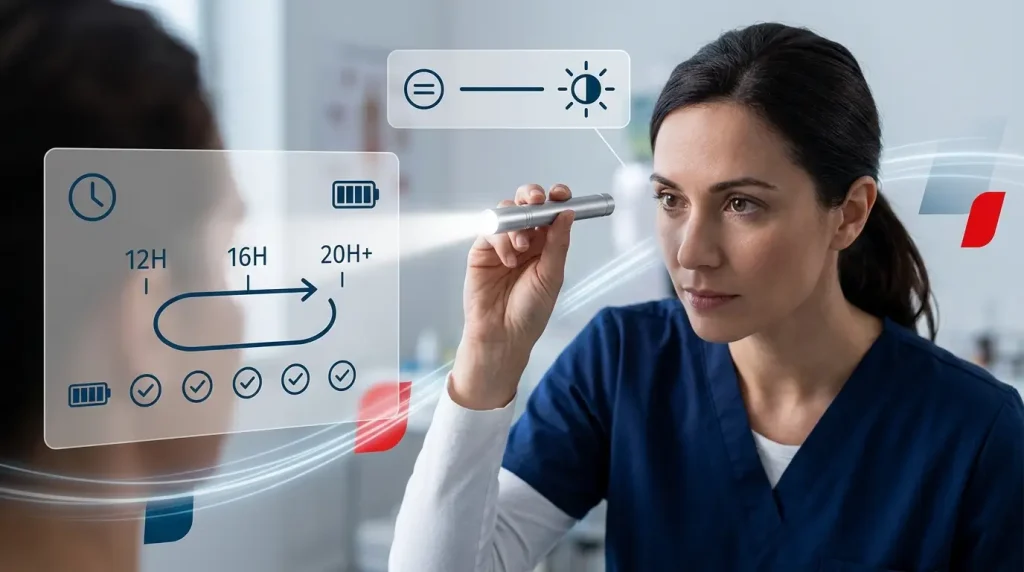
Battery life and consistent output matter during long shifts because safety officers and industrial staff need a pen torch that remains ready across multiple inspections without sudden dimming or repeated battery-related interruptions.
A torch that loses power too quickly disrupts workflow. Even if the device is compact and bright, poor battery performance makes it harder to trust during long rounds or repeated checks.
Consistent output is equally important. A stable beam allows users to inspect confidently without adjusting to changing brightness every few minutes.
Stable performance reduces interruptions in industrial settings by helping inspectors complete rounds efficiently, minimizing equipment downtime caused by unreliable lighting tools, and supporting smoother safety documentation and visual review tasks.
Caregivers and home users should look for a pen torch that is simple to operate, comfortable to hold, easy to store, and reliable enough for quick checks in low-light or care-related situations.
Simple controls and lightweight handling matter for non-technical users because caregivers and family members often need fast, stress-free access to light without learning complicated settings or handling heavy tools.
In home environments, ease of use is often more important than advanced features. A straightforward on-off switch, comfortable grip, and slim design make the torch more approachable for daily use.
This matters even more when the user is assisting another person. A tool that responds quickly and feels intuitive reduces delays and confusion.
Battery type, charging method, and ease of storage affect home convenience because caregivers benefit from a pen torch that is easy to keep ready, simple to maintain, and practical to store near essential care supplies.
At home, convenience drives consistency. If the torch is too troublesome to charge, too bulky to store, or too easy to misplace, it may not be available when needed. A practical power setup helps ensure the device remains useful.
Disposable, battery-powered, and rechargeable pen torch options each suit different buying priorities, because the right choice depends on frequency of use, maintenance preference, hygiene expectations, and long-term operating cost.
Disposable options may suit occasional use because they simplify replacement, reduce maintenance, and can be practical for buyers who only need a pen torch for limited or infrequent tasks.
For some users, convenience outweighs long-term cost. A disposable option may work for backup kits, temporary use, or specific settings where replacement is easier than maintenance.
Rechargeable pen torch models may offer better long-term value because they reduce repeated battery purchases, support frequent use, and may be more economical for clinics, factories, and high-usage professional environments.
For users who rely on the torch every day, rechargeability can improve routine efficiency. It may also simplify inventory planning, especially where multiple staff members use similar tools.
Cost, convenience, and maintenance should be compared by looking at purchase price, expected usage frequency, battery replacement needs, charging habits, and the operational demands of the actual work environment.
A low-cost torch is not always the best-value torch. Buyers should think beyond the price tag and consider how the device will perform over time.
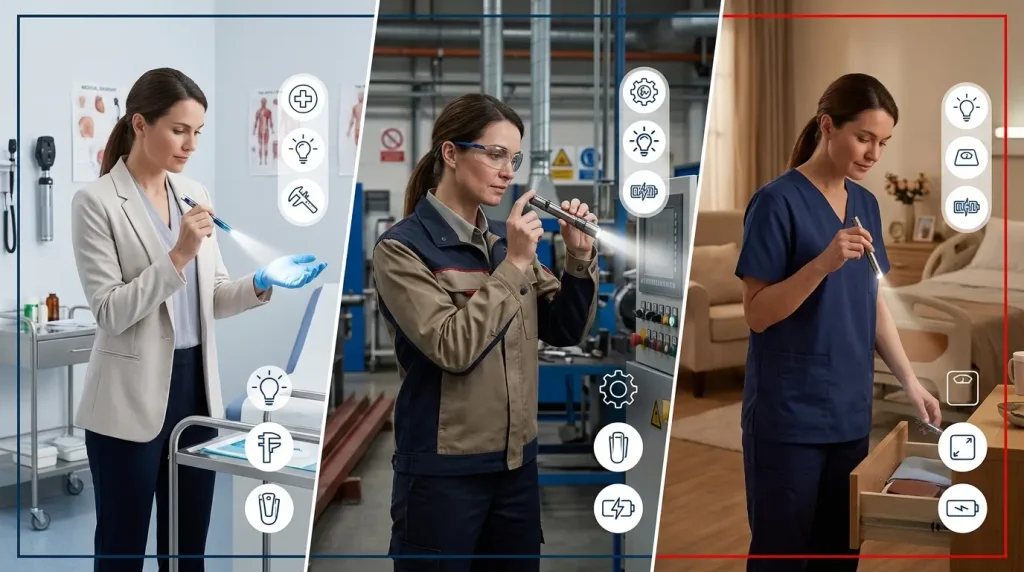
Buyers can choose the right pen torch for their environment by matching product features to real tasks, user habits, and workplace demands instead of relying only on generic specifications or promotional claims.
Clinics, factories, and caregivers should compare features based on actual use case because each environment prioritizes different needs, from patient comfort and hygiene to durability, portability, and inspection reliability.
A clinic may prioritize controlled brightness and easy cleaning. A factory may prioritize durable build and dependable activation. A caregiver may prioritize simplicity and compact storage. The best choice becomes clearer when the environment is defined first.
Brightness, build quality, power source, and portability should be balanced according to task frequency, storage habits, user comfort, and the level of reliability required in the working environment.
A balanced buying decision usually comes from eliminating features that sound impressive but add little real value. A practical pen torch light is one that performs well in the user’s routine, not just on a product label.
Common buying mistakes to avoid when selecting a pen torch include choosing excessive brightness, ignoring switch quality, overlooking portability, and focusing only on price instead of real-world usability and reliability.
Many buyers assume all pen torches perform similarly, but small differences in beam control, body design, and power setup can affect daily satisfaction significantly.
Choosing the right pen torch comes down to matching the tool to the real task.
Clinics usually need controlled brightness, clear beam quality, hygienic design, and dependable handling, while factories often benefit more from durability, stable output, and quick access during inspections.
For caregivers, simplicity, comfort, and easy storage matter most.
A practical buying decision focuses less on flashy specifications and more on how consistently the torch performs in everyday use.
If you are sourcing a reliable pen torch for healthcare, workplace inspections, or daily caregiving needs, it helps to choose from a supplier that understands both product quality and practical use. Explore AIDEL’s pen torch light product page to review a suitable option, and browse their Sickbay Supplies category if you are building out a more complete clinic or workplace first aid setup.
The essential features of a good pen torch include controlled brightness, a focused beam, comfortable handling, dependable activation, and durable construction for repeated use in clinical, industrial, and caregiving environments.
A good pen torch should provide clear close-range visibility without causing glare or discomfort. It should also be easy to carry, quick to switch on, and reliable during repeated checks. In most professional settings, stability, portability, and ease of use matter more than decorative or unnecessary extra functions.
Recommendations for a durable pen torch suitable for medical use usually focus on reusable models with stable illumination, hygienic design, and a strong outer body that supports repeated examinations and cleaning routines.
Medical professionals should prioritize a pen torch that feels solid, delivers consistent light, and remains comfortable during pupil checks, throat observation, and routine assessment tasks. A durable design helps reduce replacement frequency and supports more dependable workflow in clinics, private practices, and workplace sickbays.
Best rechargeable pen torch models available in Malaysia are usually those that combine practical charging, stable beam performance, compact design, and dependable durability for frequent everyday use.
Rechargeable models can be a strong option for clinics, factories, and regular users because they reduce reliance on disposable batteries. When comparing options, buyers should look at charging convenience, output stability, body quality, and whether the torch suits the actual inspection or examination environment.
Comparison of brightness levels for different professional penlights matters because different tasks require different output levels, and the brightest model is not always the most suitable one.
For medical observation, controlled brightness is often better because it improves comfort and supports close-range checks. For industrial inspection, a slightly stronger beam may be more useful in darker spaces. The best comparison should always consider beam focus, consistency, and working distance rather than brightness alone.
Choosing a pen torch for medical professionals means selecting a model with controlled brightness, clear beam focus, hygienic construction, and dependable handling for repeated close-range examinations.
Medical users should choose a torch that supports routine tasks such as pupil assessment, throat checks, and general observation without producing harsh glare. It should also be easy to clean, simple to carry, and durable enough for repeated use throughout the day in healthcare environments.
