
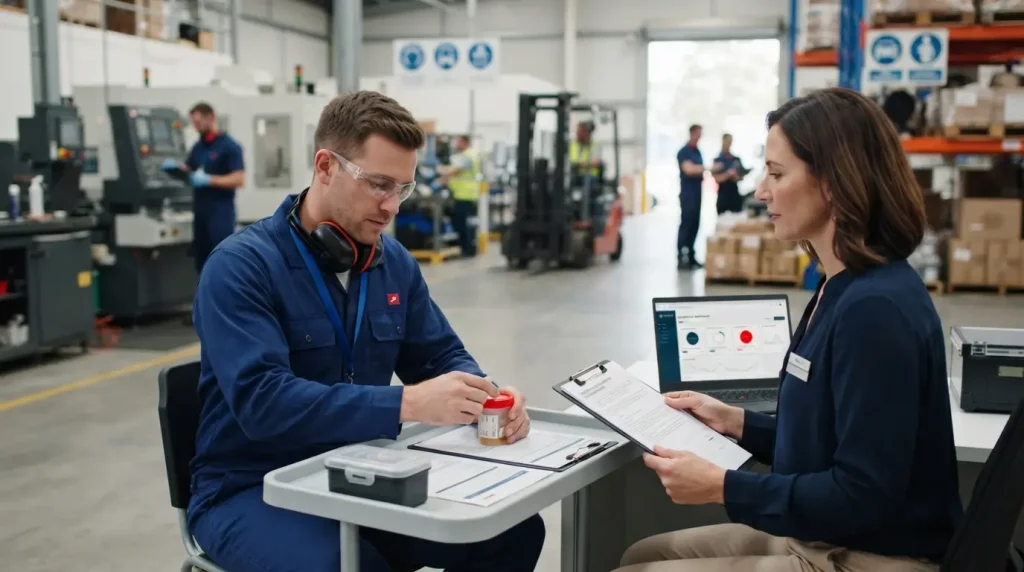
For HR and corporate management teams, deciding whether to introduce a drug test for employees is not simply a matter of buying a test kit.
The more important question is how screening fits into the organisation’s workplace safety policy, operational risks and employee-management procedures.
This is particularly relevant for safety-sensitive workplaces.
In August 2026, the Civil Aviation Authority of Malaysia (CAAM) directed Malaysian Air Operator Certificate holders to test active flight and cabin crew, strengthen unannounced random alcohol and drug testing, conduct reasonable-suspicion testing where impairment indicators arise, and review their existing testing programmes.
The example is specific to aviation, but it highlights a broader management consideration: when impairment could affect workplace safety, organisations need more than a screening product.
They need a clear process covering when testing occurs, how screening is conducted, how results are handled and what happens next.
This guide explains seven workplace policy facts employers should understand before implementing employee drug screening, including where urine drug-test products can fit into a practical workplace screening procedure.
A workplace drug test can be one part of an organisation’s approach to managing safety-sensitive risks.
For HR and management teams, its value is not simply in identifying a substance during screening.
It is in having a defined process for addressing situations where impairment could create concerns for employees, colleagues, visitors, equipment or operations.
This matters more in environments where employees perform safety-sensitive duties.
A manufacturing facility, construction operation, transport business or other industrial workplace may have different risks from a conventional office, so the organisation’s approach should reflect its actual working environment.
Drug screening should therefore be viewed as part of a wider workplace framework rather than as a stand-alone safety measure.
A practical policy may sit alongside employee awareness, supervision, workplace safety procedures, incident management and appropriate employee support.
A test kit cannot determine an organisation’s overall fitness-for-duty policy.
Management still needs to establish what the organisation is trying to achieve, which roles or situations require attention, and how screening results will be handled.
This distinction is important for HR teams.
A workplace can have suitable screening products but still lack a consistent process if different departments test employees under different circumstances or respond inconsistently to results.
A written procedure gives HR, managers and designated personnel a common reference point.

A recent Malaysian aviation development provides a useful example of how screening requirements can become an operational priority in a safety-critical environment.
SAYS reported on 10 August 2026 that the Civil Aviation Authority of Malaysia (CAAM) directed Malaysian Air Operator Certificate holders to drug-test all active flight and cabin crew within 30 days.
The report also stated that operators were required to increase unannounced random alcohol and drug testing, conduct reasonable-suspicion testing where impairment indicators arise, and review the effectiveness of their existing alcohol and drug-testing programmes.
This is an aviation-specific directive, so employers in other industries should not assume that the same requirements automatically apply to them.
However, the example highlights a useful management principle: safety-sensitive organisations may need clear screening arrangements that can operate consistently across their workforce.
The practical lesson is not that every employer should copy an aviation testing programme.
Instead, HR and management teams can ask:
Answering these questions before a situation arises can make the organisation’s process clearer and easier to administer.
One of the most important policy decisions is determining when an employee may be tested.
Depending on the organisation’s circumstances and applicable requirements, a workplace policy may address different screening situations, including:
AIDEL’s workplace screening product information also identifies pre-employment, random and incident-related screening as potential organisational use cases.
The important point is consistency.
HR should not have to decide from scratch what to do every time a testing situation arises.
A policy should make the testing circumstances understandable to the people responsible for implementing it.
For example, if an organisation uses reasonable-suspicion testing, it should establish an appropriate internal process for identifying and documenting the circumstances that may trigger the procedure.
The policy should also explain who can authorise or coordinate testing and what happens after screening.
The exact policy will depend on the organisation’s industry, risk profile, workforce and applicable requirements.
There is no single testing model that is appropriate for every employer.
A drug-testing policy is more useful when it is supported by an operational procedure.
For HR and management, this means moving beyond a general statement such as “the company may conduct drug testing” and documenting how the process is expected to work.
A practical procedure can address:
Purpose and scope
Explain why the organisation conducts screening and which employees, roles, locations or circumstances fall within the policy.
Testing circumstances
Specify whether the policy covers pre-employment, random, reasonable-suspicion or incident-related screening.
Responsibilities
Identify the people responsible for authorising, coordinating, conducting or documenting the process.
Screening process
Set out the organisation’s approved procedure for specimen collection, screening and documentation.
Result handling
Explain how an initial screening result is recorded, who receives the information and what further steps may be required.
Follow-up and review
Establish what happens when a result requires confirmation, further assessment or an employee challenge.
Confidentiality
Define who should have access to screening information and how records are handled internally.
The procedure should also be reviewed when the organisation changes its workforce, operating environment, safety risks or internal policy.
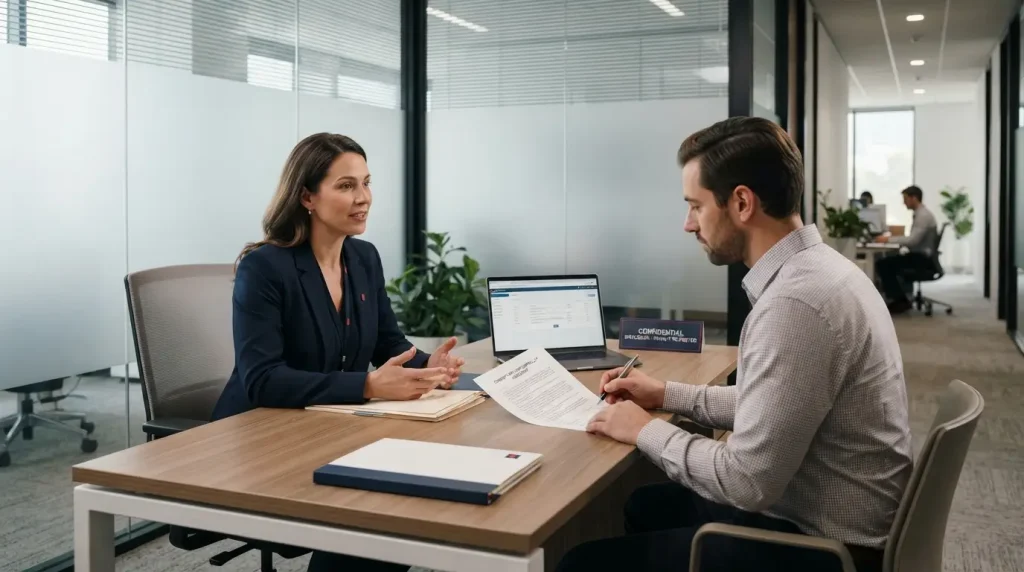
Drug screening involves information about an employee that should be handled carefully.
From an HR perspective, the process should therefore consider privacy, confidentiality and appropriate access to information from the beginning.
This is not simply a record-keeping issue.
Employees should understand what the organisation’s policy says, when screening may occur and how information generated through the process will be managed.
Organisations can establish clear internal controls around who receives screening information and who is authorised to act on it.
For example, a manager who needs to coordinate a workplace procedure may not necessarily need unrestricted access to all employee health-related records.
Organisations should establish appropriate information-handling practices based on their circumstances and applicable requirements.
Because employment and personal-data requirements can vary according to the situation, this article does not treat a general workplace-testing approach as a substitute for organisation-specific legal advice.
The practical principle is straightforward: make confidentiality part of the testing procedure rather than considering it only after a result has been produced.
One of the most important distinctions for HR teams is the difference between an initial screening result and a final determination.
Urine screening products are designed to provide an initial screening indication.
A result that requires further attention should therefore be managed according to the organisation’s established procedure and any appropriate recognised confirmation or follow-up process.
A workplace should avoid building its disciplinary process around the assumption that an initial screening result automatically establishes a definitive medical, legal or employment conclusion.
Instead, the organisation’s procedure can establish:
This approach helps separate screening, review and employment decision-making rather than treating them as the same step.
For HR teams, that distinction can be particularly useful when developing a fair and consistent internal procedure.
Once an organisation has established its policy and testing procedure, it can consider which screening products fit its operational needs.
AIDEL supplies urine drug-screening products for organisational use.
Its multi-panel Dipcard product information allows organisations to enquire based on factors such as the purpose of screening, required drug panels, expected quantity and operational needs.
This makes product selection a practical extension of the policy conversation rather than the starting point.
HR, safety and procurement teams can consider questions such as:
AIDEL’s product information indicates that screening requirements can vary according to organisational needs and SOP, so employers should identify those requirements before selecting a product.
For organisations evaluating a urine-based screening option, AIDEL’s multi-panel urine drug test can be reviewed as one potential product for an established workplace screening workflow.
The broader drug and alcohol test kits category can also help HR, safety and procurement teams explore the available screening-product options.
The key is to choose the product after the organisation has considered its workplace risks, testing purpose, internal procedure and operational requirements.
A drug test for employees can support a broader workplace safety and accountability approach, particularly when an organisation has safety-sensitive roles or operational risks that make impairment a significant concern.
The recent CAAM aviation example shows how important structured screening arrangements can become in a safety-critical environment.
However, the same approach should not simply be copied across every industry. Employers need to consider their own workplace risks, workforce, internal procedures and applicable requirements.
For HR and management teams, the practical sequence is straightforward: define the purpose, establish the testing procedure, determine when screening applies, protect screening information, and establish how results will be reviewed before selecting the appropriate screening product.
If your organisation is developing or reviewing its workplace screening process, explore AIDEL’s multi-panel urine drug test to assess whether it fits your organisation’s established screening requirements.
For broader options, you can also review AIDEL’s drug and alcohol test kits.
Different testing methods can be used for different purposes. This article focuses on urine-based screening products, including multi-panel urine tests.
The appropriate format and drug panels depend on the organisation’s screening purpose, procedure and operational requirements.
An initial screening result should not automatically be treated as a conclusive medical, employment or legal determination.
Organisations should establish a procedure for reviewing results and, where appropriate, obtaining recognised confirmation or further assessment before making consequential decisions.
A policy may address circumstances such as pre-employment, random, reasonable-suspicion or incident-related screening.
Which circumstances are appropriate depends on the organisation, its workplace risks and applicable requirements.
Start with the organisation’s SOP and identify the screening purpose, relevant drug panels, expected testing volume, workflow and responsibilities.
Product selection should follow those requirements rather than simply choosing a test based on the number of panels offered.
