
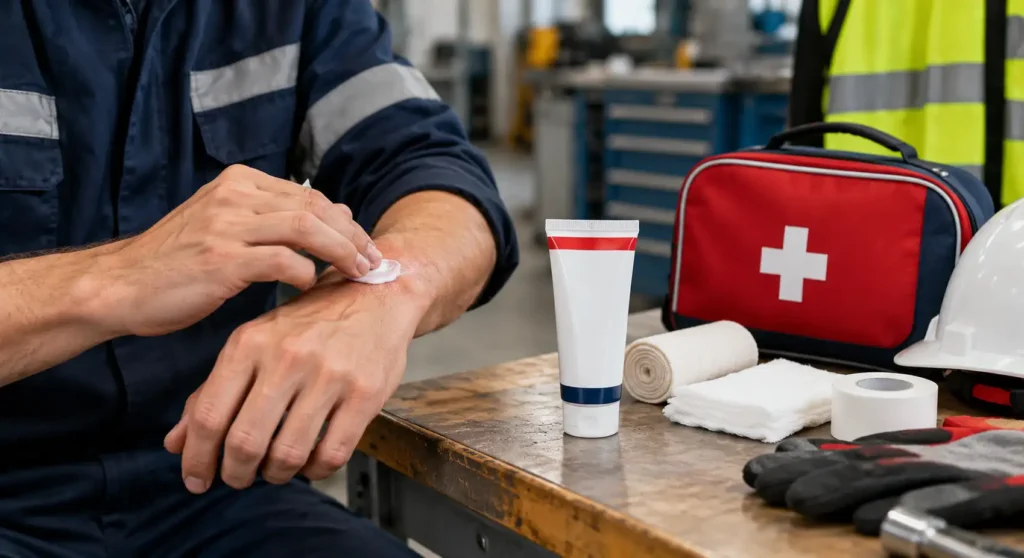
A minor burn can happen quickly in workplaces such as kitchens, factories, workshops, laboratories and maintenance areas.
When this happens, it may be tempting to immediately reach for a cream for burn skin.
However, not every burn should be managed in the same way, and a topical product should not replace proper assessment and appropriate first aid.
The first priority is to understand how the burn happened, how serious it may be and whether it can reasonably be managed as a minor injury or requires further medical assessment.
Heat, steam, hot liquids, chemicals, electricity and heated equipment can cause different types of burn injuries, and the correct response may vary according to the mechanism and severity.
For workplace first aiders, EHS teams and operational managers, the key question is therefore not simply which cream to use.
It is when cream for burn skin may have an appropriate role, what should happen before it is considered, and when a burn should be escalated instead.
This article explains those decisions through seven practical workplace-focused facts.
The phrase cream for burn skin can refer to different topical products intended for different types of skin injury or stages of wound care.
It should not be treated as though there is one universal cream suitable for every burn.
Some topical products may be intended to protect or moisturise damaged skin, while others may contain active ingredients for more specific uses.
Prescription products can also have very different indications from products intended for general first aid.
A product labelled for burn care should be used according to its intended purpose, instructions and any relevant healthcare advice.
This is particularly important in a workplace because first aiders may encounter very different injuries.
A brief contact with a hot surface is not the same as a chemical exposure, an electrical incident or a larger thermal burn.
Before considering any topical product, the responder should first determine how the injury occurred and whether it appears appropriate for routine minor first aid.
The practical question should therefore be:
“What type of burn are we dealing with?”
rather than immediately:
“Which cream should we apply?”
That distinction helps prevent a topical product from becoming a substitute for proper assessment.
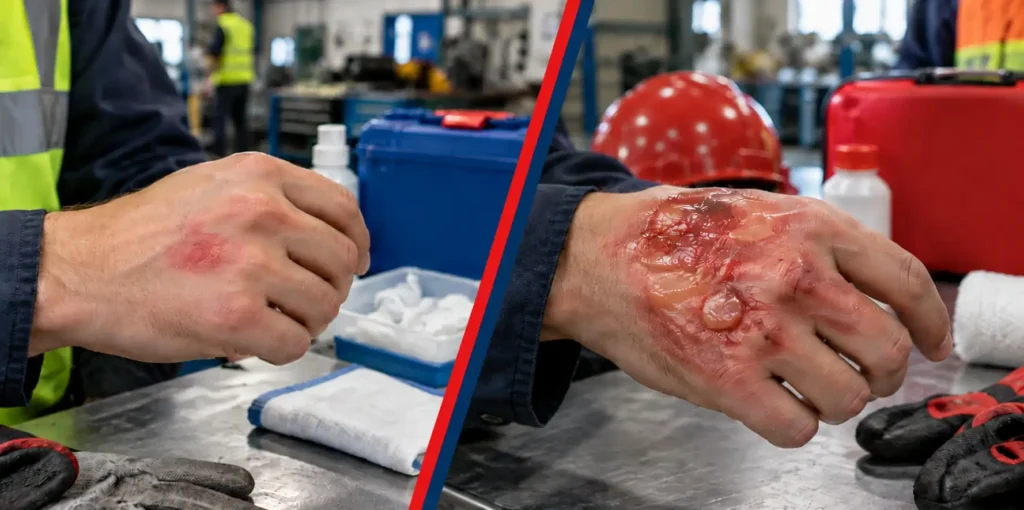
Burn injuries can vary considerably.
Their seriousness may depend on factors such as how the injury happened, the area affected, its appearance and where it is located on the body.
A workplace first aider should avoid assessing a burn only by how painful it feels or how red the skin appears.
An apparently minor superficial burn may affect only the outer layers of skin, while a deeper injury may involve more significant tissue damage.
Before deciding whether cream for burn skin has any role, consider:
The mechanism of injury is also important.
Workplace burns can occur through contact with:
A workplace burn involving electricity or chemicals should not automatically be treated in the same way as a simple minor thermal burn. text matters just as much as the visible skin injury.
Applying a topical product should not be the first automatic response to every workplace burn.
The immediate priorities are to stop further exposure, make the area safe and provide appropriate first aid based on the type of burn.
If a worker is still exposed to the source of heat or another hazard, the first step is to prevent further injury without placing the responder at risk.
For example, this may involve:
Electrical and chemical incidents may require additional hazard-specific precautions before assistance can be provided safely.
For certain minor thermal burns, cooling forms part of recognised first-aid management, but the correct method and duration should be verified against approved first-aid guidance.
Workplace procedures should therefore specify the appropriate first-aid response instead of relying on staff to improvise.
A moisturiser, antiseptic cream, antibiotic preparation or other skin product should not be assumed to be suitable simply because it is available in the workplace.
The product’s intended use, ingredients, instructions and the nature of the burn all matter.
This is especially relevant in shared first aid rooms and industrial first aid kits, where products should be selected deliberately rather than added without a clear purpose.
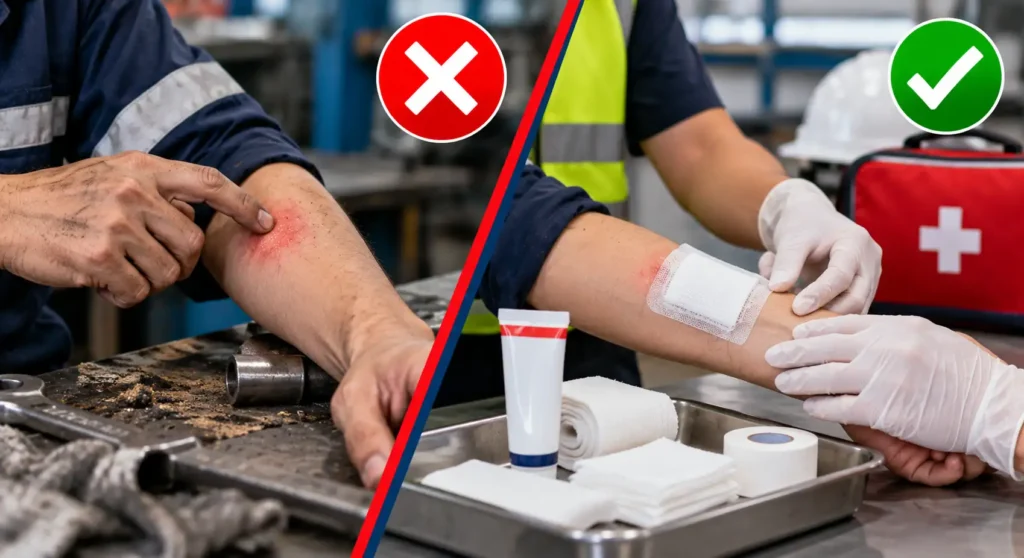
A cream for burn skin may have a role in some minor burn-care situations, but only when the type of injury and the product’s intended use are appropriate.
It should be viewed as one possible component of care rather than the entire treatment.
Different topical products may be designed for different functions, such as protecting the skin, maintaining moisture or providing a specific medicated treatment.
That means two products marketed for burns may not be interchangeable.
Before use, workplace first aiders should check:
Where a topical product is considered suitable, the label instructions and any relevant professional advice should take priority over assumptions based on previous experience.
This is particularly important with medicated or prescription products.
Even a product specifically intended for burn care does not determine whether an injury is minor.
If the burn appears more serious, resulted from a higher-risk mechanism or is not improving as expected, further medical assessment may be more appropriate than continued topical treatment.
Initial first aid does not end after a topical product is considered.
The affected area may need to be protected and monitored during the early stages of recovery.
Depending on the nature of the burn, an appropriate dressing or protective covering may be recommended to help protect the affected area.
The correct dressing type should be based on suitable first-aid guidance rather than whatever material happens to be available.
This is one reason organisations should periodically review their workplace first aid supplies rather than waiting until an injury occurs.
A burn that initially appears minor may require further assessment if its condition changes or if concerns develop during recovery.
Workplace first aiders should know when internal procedures require:
The exact medical warning signs should be verified by an appropriate qualified reviewer before publication.
Organisations should have a clear process for recording workplace injuries and escalating incidents where necessary.
This does not mean every minor burn becomes a major emergency.
It means responsibilities should be understood in advance so that staff are not deciding procedures for the first time during an incident.
There are situations where applying cream for burn skin should not be treated as the main response.
A burn that appears serious, involves a higher-risk mechanism or falls outside the scope of routine workplace first aid may require prompt medical assessment.
Larger or deeper burns and burns involving certain parts of the body may require professional medical evaluation rather than topical treatment alone.
The specific size, depth and anatomical criteria should be confirmed through approved clinical guidance before publication.
Chemical exposures require particular care because the substance involved can affect the appropriate response.
A workplace handling chemicals should have procedures covering:
Applying a generic burn cream without first addressing the chemical exposure may be inappropriate.
Electrical injuries can involve hazards that are not obvious from the appearance of the skin alone.
Before assisting, responders must also consider whether the electrical source remains dangerous.
Electrical incidents should therefore follow the organisation’s emergency procedure rather than being treated simply as a minor skin burn.
If the injury falls outside the scope of routine first aid, further medical assessment should take priority over continuing to apply topical products.
The key workplace principle is simple:
Do not allow the availability of a burn cream to create false reassurance about the seriousness of an injury.
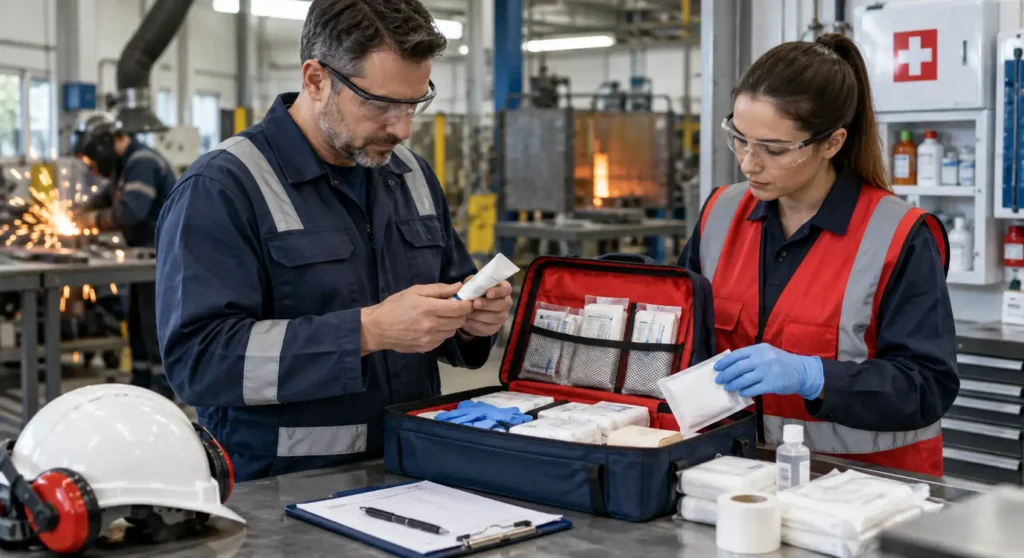
The best time to determine how a workplace should respond to a burn is before an incident occurs.
Preparation can help staff understand where first aid supplies are located, who is responsible for responding and when an incident needs to be escalated.
Different workplaces face different burn hazards.
Examples include:
Identifying these hazards can form part of broader workplace accident prevention efforts.
The objective is not to assume that every hazard can be eliminated, but to understand where injuries could occur and prepare an appropriate response.
A small office and a manufacturing facility may not have identical first aid requirements.
Organisations should consider factors such as:
AIDEL’s Emergency Trauma Bag Supplies category also provides a broader reference point for organisations reviewing emergency-response equipment alongside routine first aid resources.
The presence of equipment alone, however, does not guarantee that a workplace is fully prepared.
First aid supplies can become less useful if items are:
Regular checks can help workplaces identify these issues before an emergency occurs.
Responsibility for inspections and replenishment should also be clearly assigned within the organisation.
Equipment is only one part of workplace preparedness.
Appointed first aiders, EHS personnel and relevant employees should understand:
A broader workplace emergency management approach can help organisations consider these responsibilities alongside communication, equipment and response planning.
For burn injuries specifically, staff should understand that cream for burn skin is not the starting point for every incident.
The starting point is recognising the hazard, assessing the situation, following suitable first-aid procedures and escalating appropriately when the injury exceeds the scope of minor first aid.
A cream for burn skin may have a role in some minor workplace burn-care situations, but it should never replace proper assessment, appropriate first aid or medical escalation when the injury appears more serious.
For workplace decision-makers, the more useful question is not simply,
“Which cream should we keep?”
It is whether the organisation has a suitable process for recognising burn hazards, responding appropriately, protecting the injured person and knowing when further medical assessment is needed.
Workplaces should also review whether their first aid supplies match their operating environment, workforce size, facility layout and foreseeable risks.
AIDEL supplies industrial first aid kit supplies for corporate, industrial and institutional environments.
Organisations can review their existing kit contents, replacement items and workplace first aid arrangements according to their own operational needs.
The presence of burn-care products or first aid equipment alone does not guarantee complete preparedness.
Suitable supplies work best alongside clear procedures, regular inspection, responsible personnel and appropriate first-aid training.
Not automatically.
The burn should first be assessed, further exposure should be stopped safely and appropriate initial first aid should be provided.
Whether a topical product is suitable depends on the type of burn, its severity and the product’s intended use.
No single topical product should be assumed to be suitable for every burn.
Thermal, chemical and electrical burns can require different responses, while deeper, extensive or otherwise concerning burns may require professional medical assessment rather than topical care alone.
Blistering can indicate a deeper degree of skin injury than simple redness, so the burn should be assessed before any cream or other topical product is used.
The appropriate care depends on the extent, location and condition of the burn.
A workplace burn should be escalated when it appears outside the scope of routine minor first aid, involves a higher-risk mechanism such as chemical or electrical exposure, appears deep or extensive, affects a high-risk area, or causes other concerns.
The final escalation criteria should be verified against approved clinical guidance before publication.
